Home / About

About the studio

A course studio run by people who still ship code

DevCourseLab started at a library table in Royse City, Texas. Eight years later we are still small on purpose — four mentors, a hard cap on every cohort, and feedback that does not flatter.

2026 founded in Royse City, TX
2,400+ graduates and counting
16 active courses
10–16 students per cohort, always
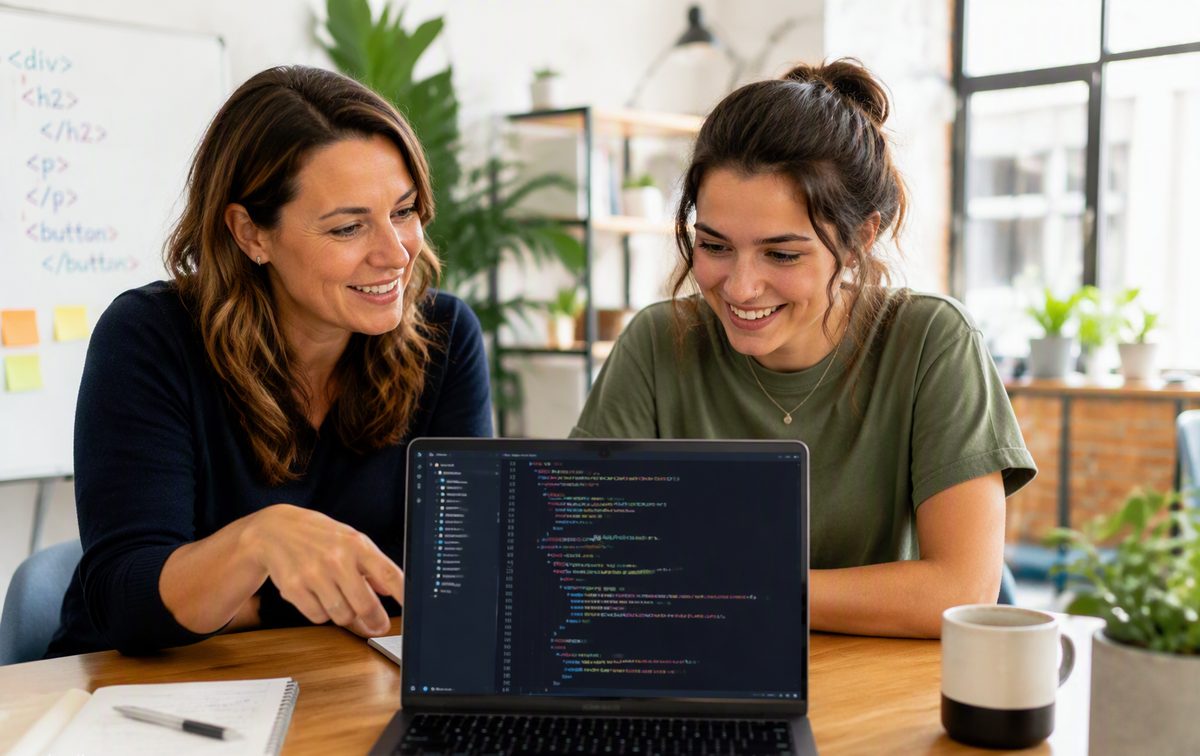
DevCourseLab founder Briona R. Busby reviewing a project together with a student on one laptop
Founded 2026fully online ever since
The founder

Briona learned to code at 17. Nobody taught her the parts that mattered.

Briona R. Busby taught herself programming at seventeen, mostly from library computers and secondhand books. She started a computer science degree, dropped out when the coursework felt a decade behind the industry, and went to work as an engineer instead. Eight years of it — shipping, breaking, fixing, and being reviewed by people better than her.

In 2018 she started running free Saturday workshops for local beginners at the Royse City public library. Learners could follow tutorials fine. What they could not do was read an error message, use Git without fear, or take criticism on their code. So that is what she taught.

DevCourseLab became a real business in 2026 — registered as BUSBY BRIONA RAQUEL LLC, with a first paid cohort of nine students in a single course called “Web Basics.” Marcus and Priya joined soon after as the first outside mentors, Diego followed, and the Saturday office-hours habit became permanent policy. The rules from the library table still hold: cohorts stay small enough that the mentor knows your name and your repo, every week ends with working code, and feedback is honest even when it stings a little.

Why not scale up? We get asked. Because a cohort of 200 is a webinar, not a class. We would rather run four cohorts of 14 than one of 56.
Where we actually are. Every course is taught fully online, live, to students well outside Texas. The Royse City address in the footer is our registered headquarters — where the mail goes and the Wi-Fi gets fixed — not a campus. There is no campus.

What we believe

Three rules we do not bend

These are not posters on a wall. They are the reasons students finish our courses with a portfolio instead of a participation badge.

Small on purpose

Every cohort caps at 10 to 16 students, depending on the course. That is the number where a mentor can actually read every pull request, notice who went quiet, and remember who is afraid of recursion. Past that, you are selling seats, not teaching.

Code over certificates

Yes, you get a certificate at the end. Nobody hires you for it. What gets interviews is a public GitHub repo full of reviewed, tested, working projects — so every week of every course ends with code pushed to yours.

Honest feedback

If your variable names are bad, we say so. If a course is wrong for you, we tell you before you pay, not after. Flattery is cheap and helps no one; a specific comment on line 42 of your pull request is worth a month of guessing.

The team

Four people. No sales department.

When you email DevCourseLab, one of these four reads it. Everyone here teaches at least one course and writes code for a living outside it.

Briona R. BusbyFounder & Mentor

Self-taught at 17, eight years in industry, teaching since 2018. Briona still leads one Foundations cohort a year to stay close to what beginners actually trip over. She writes the curriculum, answers the contact form, and fixes the office Wi-Fi. Usually in that order.

Marcus FeldBackend & System Design

Twelve years building payment infrastructure, including systems that move real money at real scale. Marcus teaches Backend Engineering and System Design, and is famous for review comments that start with “what happens when this fails at 3 a.m.?” Students stop finding it funny around week three, when it saves their capstone.

Priya RamanFrontend & Accessibility

Design systems lead at a company you have probably used, mentor here by night. Priya runs Foundations of Web Development and React & Modern Frontend. Her standing rule: you do not ship your project until you have navigated the whole thing with a keyboard, out loud, in front of the cohort.

Diego AlvarezDatabases & Career Track

Former hiring manager at two startups, where he read roughly four thousand resumes and ran hundreds of interviews. Diego teaches data modeling and runs the Career Track, including the mock interviews students describe as “scarier than the real thing.” That is the point.

What graduates say

The part a commit log cannot show

The story above is dates and numbers. This is what it feels like from the student side of the table.

“My first real interview had a whiteboard round and an interviewer who interrupted me every ninety seconds. It was still easier than Diego's mock. Halfway through I caught myself thinking, ‘he is going easier on me than Diego did’ — and after that I stopped being nervous.”
Nadia P., 22Career Track graduate, hired as a junior backend dev
“Forty applications before the course, total silence. Then my mentor went through my GitHub repo by repo — pinned projects, READMEs that say something, tests that pass — and three recruiters wrote to me in a month. Same person, same skills, better evidence.”
Ethan C., 29Foundations graduate, now a frontend developer
“Priya sent my final project back the first time. Keyboard navigation, missing alt text, a button that did nothing. She was right about all three. I fixed it, resubmitted, and now I catch the same problems in other people's work — which, it turns out, was the point.”
Sam O., 21React & Modern Frontend graduate
Next step

Like how we think? Come learn with us.

Sixteen courses, live cohorts of ten to sixteen, and a mentor who reads your code and tells you the truth about it. Browse the catalog — or write to us first if you are not sure where you fit.

Browse courses Talk to us first